
NEW CONSTRUCTION OF BACH HOP NURSING SCHOOL, BINH TAN DISTRICT
I. GENERAL INFORMATION ABOUT THE PROJECT
Project scale
Project name: New construction of Bach Hop Kindergarten, Binh Tan district
Project owner: Construction Investment Project Management Board in Binh Tan District
Location status:
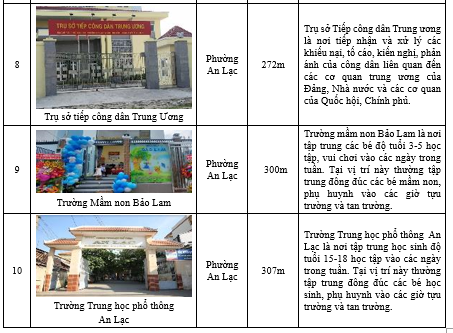
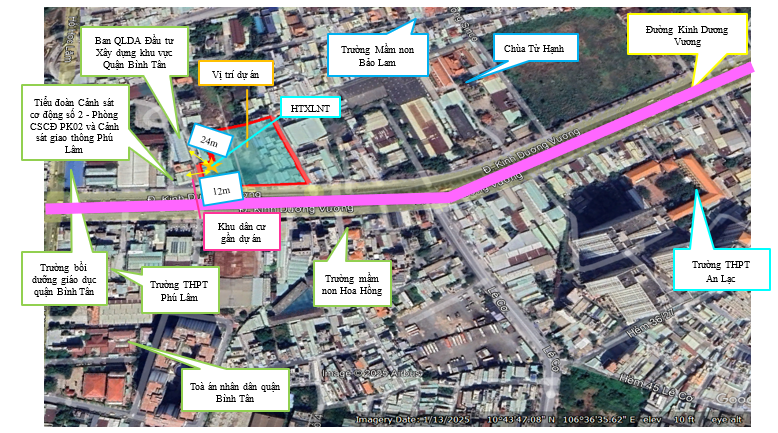
The land area for the project is about 7,522.3 m2 in An Lac ward, Ho Chi Minh City. Currently, the land area where the project will be implemented is an existing residential area, with mainly individual houses and a part of vacant land being used as a parking lot; According to Decision No. 3213/QD-UBND dated June 26, 2025 of Ho Chi Minh City People's Committee on Investment Policy for the project of new construction of Bach Hop kindergarten, Binh Tan district, the total investment of the project is 703.572 billion VND; The project belongs to group B according to the provisions of Clause 4, Article 10 of the Law on Public Investment No. 58/2024/QH15 dated December 29, 2024.
Project implementation location: An Lac Ward, City. Ho Chi Minh
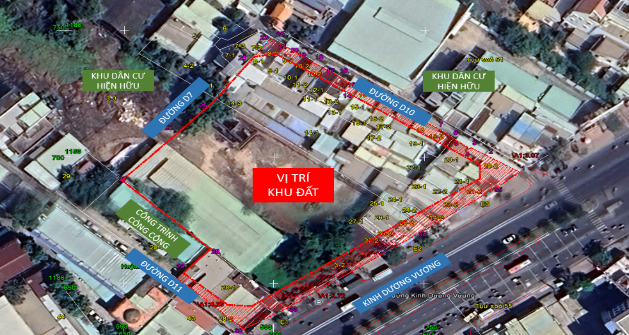
Current status of the project
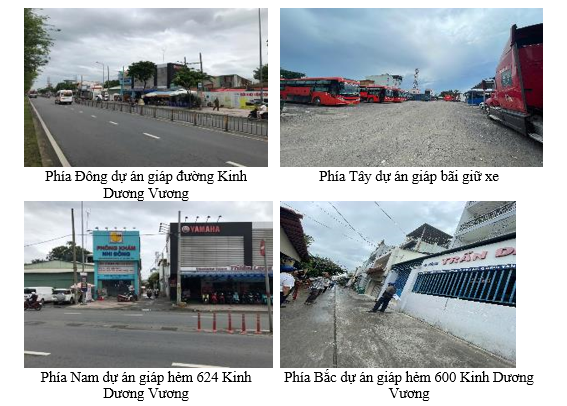
Project scale
+ Land recovery, site clearance:
- Land recovery, site clearance: The project will recover 7,364.7 m2 of land to implement the project. Of which: 3,559.2 m2 (Residential land); 1,083.9 m2 (Non-agricultural land), 2,675.4 m2 (Agricultural land); 46.2 m2 (Road land).
+ Main project items: main building block (03 floors)
+ Environmental protection project categories: Construction The rainwater drainage system is designed separately from the wastewater drainage system; Wastewater generated from the project is passed through the wastewater treatment plant with a capacity of 160 m3/day and night, meeting QCVN 14:2025/BTNMT (Column A), before draining into Kinh Duong Vuong street.
+ Category of auxiliary works: : Security house, parking garage, power station, green land, traffic.
Wastewater receiving source of the project
The project's treated wastewater is connected to the general drainage system on Kinh Duong Vuong Street, under the management of the Technical Infrastructure Management Center; The connection is carried out in accordance with the authority according to Official Dispatch No. 3043/TTQLHTKT-HTTN dated December 22, 2025.
From the general drainage system, wastewater flows to Nuoc Len canal (about 516m from the project), in the city center basin.
According to Decision No. 24/2025/QD-UBND, Nuoc Len Canal belongs to the wastewater receiving area applying Level A; Therefore, the project's investment in a wastewater treatment system with a capacity of 160 m³/day and night, ensuring that treated wastewater meets Column A - QCVN 14:2025/BTNMT before being discharged into the general drainage system is in accordance with current zoning regulations and environmental protection requirements.
How it works
Operating in the form of boarding, hours from 07:00 - 17:00, from Monday to Friday; Do not teach or take extra classes and do not rent facilities for other than educational purposes.
Scale of 30 classrooms, serving about 750 preschool children and 96 officials, teachers and staff.
Child rearing, care and education activities are carried out according to the Preschool Education Program of the Ministry of Education and Training, ensuring nutritional requirements, food safety and hygiene and health care.
The project invests in a synchronous system of classrooms, function rooms, administrative areas, boarding kitchens, playgrounds and auxiliary items, contributing to reducing the load on existing facilities and improving the quality of preschool education in the area.
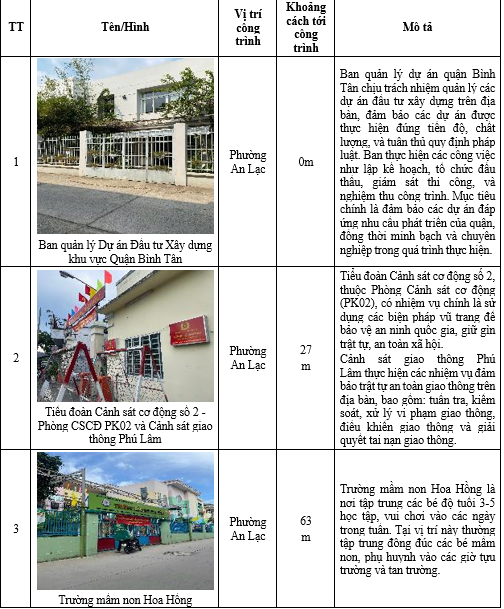
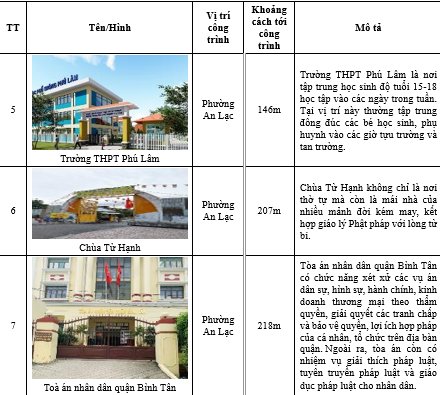
II. ASSESSING AND FORECASTING THE ENVIRONMENTAL IMPACT OF INVESTMENT PROJECTS AND PROPOSING ENVIRONMENTAL PROTECTION WORKS AND MEASURES
CONSTRUCTION PHASE
A. SOURCES OF WASTE RELATED IMPACT
1. Air environment
SOURCES OF POLLUTION
+ Dust Emissions generated from site clearance activities
+ Dust and emissions generated from transportation and construction vehicles;
+ Dust and emissions arising from construction activities: site leveling, water supply system, wastewater drainage system, …….
MITIGATION MEASURES
+ Plan, schedule, organize construction properly, the project is built quickly and completed early;
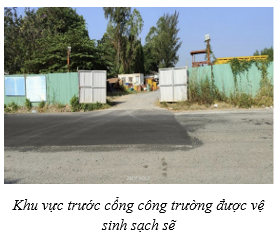
+ Use guard fences along the project route. The fence is sturdy, reflective at night and placed at least 1m from the edge of the excavation. The construction area must be well lit at night
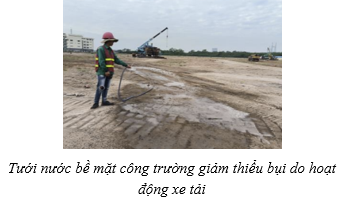
+ Water twice a day in the construction area and main transportation route.
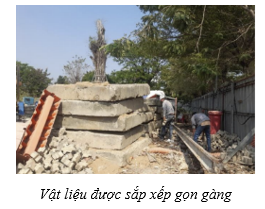
+ Covering material warehouses, covering vehicles carrying raw materials
+ Reduce machine idle time.
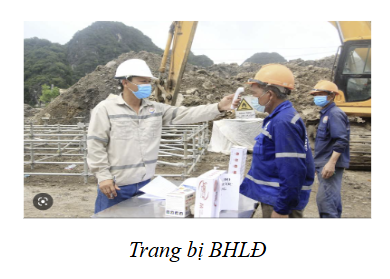
+ Labor protection equipment for workers directly performing construction such as boots, masks...
2. Water environment
SOURCES OF POLLUTION
+ Domestic wastewater of workers;
+ Rainwater overflows;
+ Wastewater from construction activities;
+ Water contaminated with oil from construction vehicles.
MITIGATION MEASURES
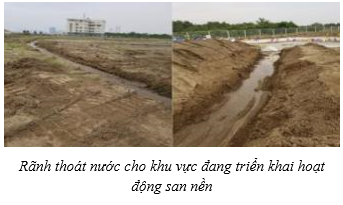
+ Rainwater runoff: build temporary drainage ditches/trenches right in the project area, regularly clearing the flow.
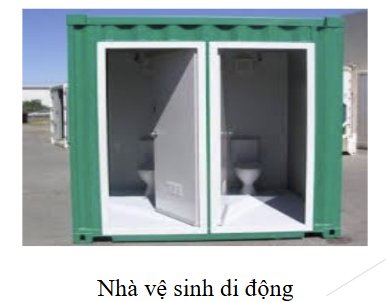
+ Domestic wastewater: Equip mobile toilets for workers. Periodically contract with a unit that has the function of collecting and treating wastewater and septic tank sludge in accordance with current regulations.
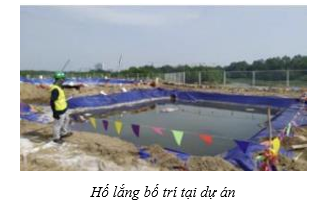
+ Construction wastewater: Build a preliminary wastewater sedimentation pit at the construction area. Sediment and lubricants are collected and transferred to the unit with treatment function. Wastewater after the settling pit is pumped to the receiving source.
+ Maintain equipment and machinery to limit oil leaks, etc.
3. Solid waste
SOURCES OF POLLUTION
+ Domestic solid waste arises from workers' activities.
+ Construction solid waste arising during the construction phase
+ Hazardous waste generated from cleaning and maintenance of machinery
MITIGATION MEASURES
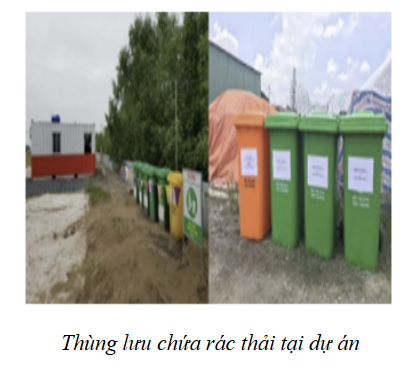
+ Equipped with at least trash bins to collect and store household solid waste;
+ Sign contracts with functional units to collect, transport and treat generated solid waste
+ Do a good job of classifying daily-life solid waste from construction solid waste. Any type of solid waste that can be reused, especially construction solid waste that can be utilized for leveling purposes, must be thoroughly used.
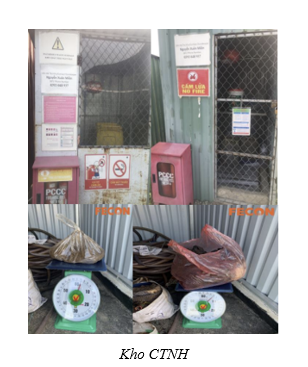
+ Classify hazardous waste, do not mix hazardous waste of different types with each other or with other waste.
B. SOURCES OF IMPACT NOT RELATED TO WASTE
1. Noise, vibration
SOURCES OF POLLUTION
+ Noise and vibration from transportation and construction vehicles
MITIGATION MEASURES
+ Make a reasonable construction plan
+ Apply advanced construction methods.
+ Transportation vehicles are limited to operate from 9pm to 6am
+ Equip labor protection equipment for workers.
2. Security and order situation
SOURCES OF POLLUTION
+ Increase in social evils
MITIGATION MEASURES
+ Propagating awareness to workers
+ Declare the number of workers, recruit workers locally
+ Post and implement construction site regulations throughout the construction phase
3. Risks and incidents during construction
SOURCES OF POLLUTION
+ The risk of accidents increases
+ Risk of fire and explosion
+ Risk of subsidence and landslides in foundation pits
MITIGATION MEASURES
+ Develop and promulgate working regulations at the construction site, including regulations on entering and leaving the construction site; regulations on labor protective clothing; Rules for using machinery and equipment; regulations on electrical safety; traffic safety; fire safety;…
+ Flammable solvents and fuels will be stored in separate warehouses, away from sources of ignition and sparks;
+ Ensure safe storage and use of chemicals, in accordance with regulations on location and storage conditions.
OPERATION PHASE
Sources of wastewater generation and mitigation measures
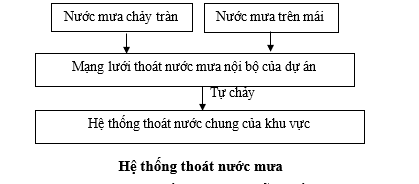
Sources of wastewater discharged through the storm water drainage system include the following sources:
+ Source No. 01: Rainwater arises from surface runoff;
+ Source number 02: Rainwater on the roof
Wastewater arises from the following sources:
Source No. 01: Domestic wastewater generated from toilets (from toilets, urinals) of floors of the main building block.
Source No. 02: Domestic wastewater generated from sinks and floor drains of floors in the main building block.
Source No. 03: Wastewater generated from the sinks of the laboratories of the main construction block.
Source No. 04: Wastewater generated from the kitchen of multi-purpose houses and kitchens.
Source No. 05: Domestic wastewater generated from toilets (from toilets, urinals) on floors of multi-purpose buildings and kitchens.
Source No. 06: Domestic wastewater generated from sinks, floor drains of floors of multi-purpose houses and kitchens.
Source No. 07: Wastewater generated from cleaning trash bins and cleaning trash storage areas.
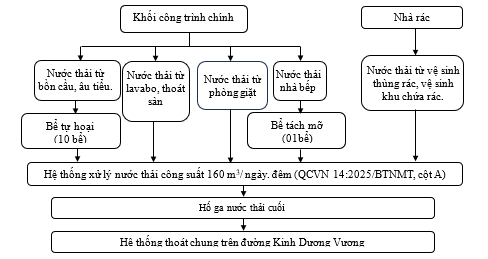
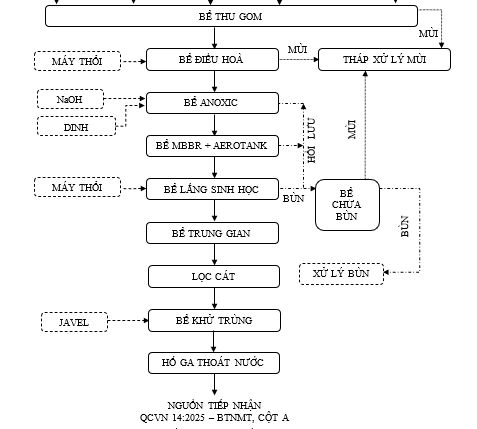
A. SOURCES OF WASTE RELATED IMPACT
1. Solid waste
SOURCES OF POLLUTION
Source No. 1: Domestic solid waste generated from eating and drinking activities, daily activities of staff and students, food processing activities in the kitchen;
Source No. 2: Bulky solid waste generated from tree pruning activities (dry, broken branches, etc.) and removal of large damaged items (tables, cabinets, chairs, etc.).
Source No. 3: Sludge from wastewater treatment systems, sludge from septic tanks
Source No. 4: Grease generated from grease separator
Source No. 5: Medical waste generated from medical room operations is waste that does not require special collection or treatment to prevent infection.
Source No. 6: Hazardous waste generated in the composition of domestic solid waste.
MITIGATION MEASURES
Collect, classify and hand over to the unit with the function of collecting and processing according to regulations
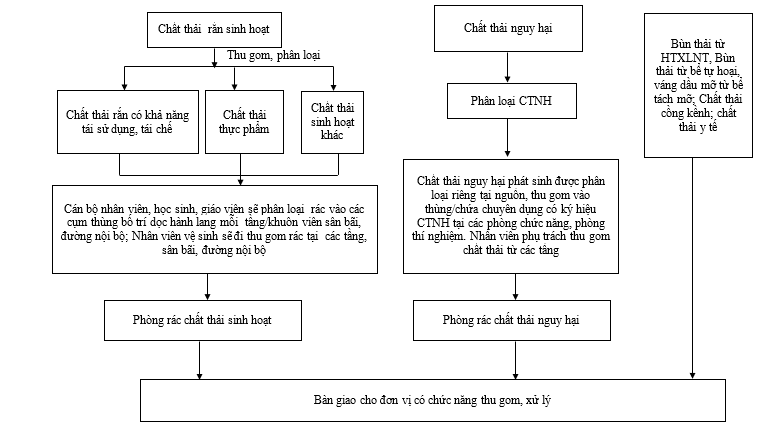
Diagram of waste collection during operation
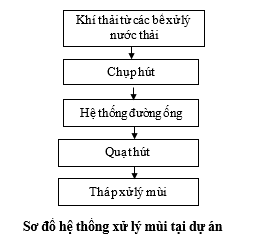
Sources of emissions and mitigation measures
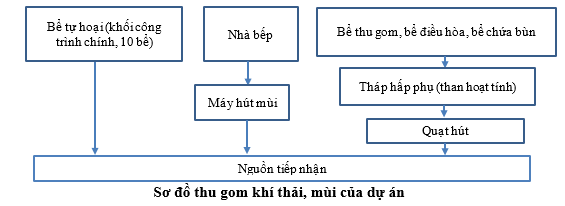
Sources of emissions and mitigation measures
III. Contents of request for issuance of driving license
Content of request for permit for wastewater:
+ Source of wastewater generation
Source No. 01: Domestic wastewater generated from toilets (from toilets, urinals) of floors of the main building block.
Source No. 02: Domestic wastewater generated from sinks and floor drains of floors in the main building block.
Source No. 03: Wastewater generated from the kitchen of the main building block.
Source No. 04: Wastewater generated from the laundry room of the main building block
Source No. 05: Wastewater generated from cleaning trash bins and cleaning trash storage areas.
Content of request for permit for wastewater:
+ Wastewater receiving source
The general drainage system is on Kinh Duong Vuong street, then flows to Nuoc Len canal
+ Waste discharge location
Connection manhole: coordinates: X = 1,186,643; Y = 593,717.
Maximum wastewater discharge flow: The largest discharge flow is 6.7 m3/hour, equivalent to 160 m3/day and night
+ Discharge method: Forced (using pump)
+ Discharge mode: continuously (24/24 hours)
Source of emissions
Source No. 01: Exhaust gas and odor arising from the odor treatment tower exhaust pipe of the wastewater treatment system.
Waste discharge location: Bach Hop Kindergarten in An Lac ward, Ho Chi Minh City
01 exhaust gas stream from the odor treatment tower of the wastewater treatment system, coordinates of the discharge location: X= 1186656; Y= 593678
Maximum exhaust flow: 1,090 m3/hour.
Discharge method: Exhaust gases and odors are discharged into the environment through uPVC pipes with a diameter of 60 mm, 2.8 m high (above the ground), and are discharged continuously (24h/24h)
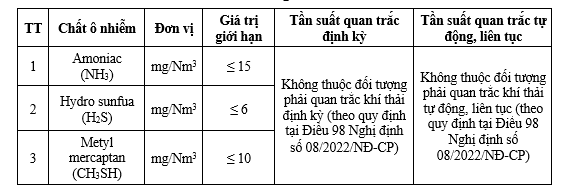
Exhaust gas quality before discharge: The quality of exhaust gas before being discharged into the environment must ensure that it meets the requirements for environmental protection and meets the National Technical Regulation on industrial emissions - QCVN 19:2024/BTNMT, column A, specifically as follows:
Sources of noise and vibration:
- Source No. 01: Noise and vibration from WWTP with capacity of 160 m3/day.night
Location of noise and vibration
- Source number 01: Coordinates: Coordinates: X = 1186653; Y = 593675;
- (VN2000 coordinate system, axis meridian 105045', projection zone 30).
Content of license request for noise and vibration
+ Limit values for noise and vibration
Noise
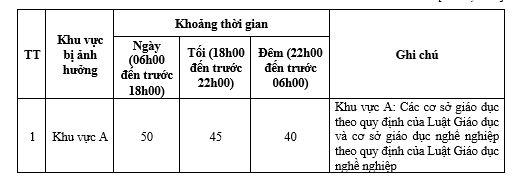
Noise must ensure to meet environmental protection requirements and QCVN 26:2025/BNNMT - National Technical Regulations on noise, specifically as follows:
Table: Limit values for noise
Vibration
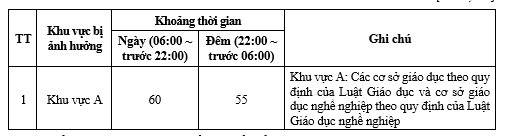
Vibration must ensure to meet environmental protection requirements and QCVN 27:2025/BNNMT - National Technical Regulation on vibration, specifically as follows:
Table: Limit values for vibration
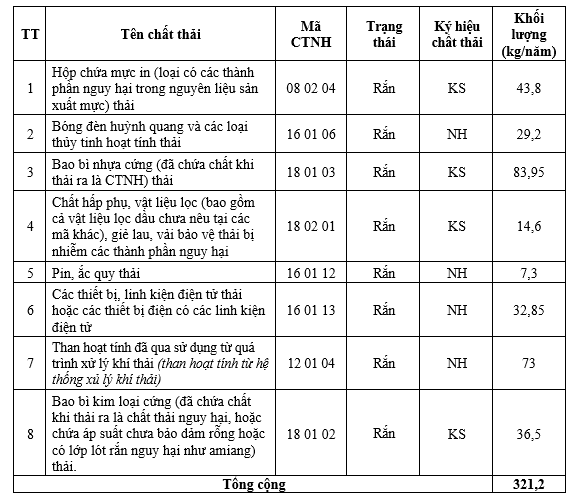
+ Management of frequently generated hazardous waste
+ Management of commonly generated waste
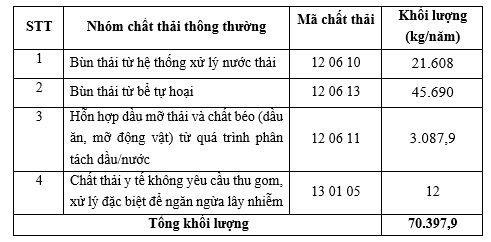
Volume of domestic solid waste generated: 324.2 (tons/year)
Volume and types of bulky solid waste: Major components such as tables, chairs, cabinets...discarded; The generated volume is about 100 kg/year
IV. Test operation plan, monitoring program
Estimated time of trial operation
+ According to Clause 13, Article 1 of Decree No. 05/2025/ND-CP dated January 6, 2025 amending and supplementing a number of articles of Decree No. 08/2022/ND-CP dated January 10, 2022 of the Government detailing a number of articles of the Law on Environmental Protection: Septic tanks, grease separators, adsorption towers are not subject to VHTN.
+ According to Clause 13, Article 1 of Decree No. 05/2025/ND-CP dated January 6, 2025 amending and supplementing a number of articles of Decree No. 08/2022/ND-CP dated January 10, 2022 of the Government detailing a number of articles of the Law on Environmental Protection: VHTN time is decided by the investor and is solely responsible.
+Estimated capacity of the Project's wastewater treatment system at the end of the trial operation phase: 20%
+ Plan for trial operation of the project's environmental protection works within 1 month and 1 day for the centralized capacity wastewater treatment system 160 m3/day.night
Detailed list of trial operation plans for completed waste treatment works
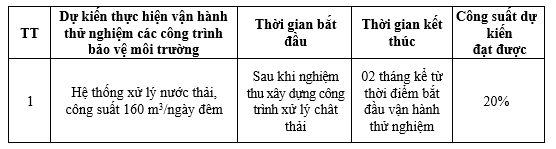
Time to start trial operation: After completing the waste treatment works licensed under the environmental license (The investment project owner will send a notice of the project's trial operation plan and waste treatment work items to the environmental licensing agency at least 10 days in advance from the date of starting the trial operation of the waste treatment works for monitoring and supervision)
End time of test operation: 02 months from the start of trial operation (The investment project owner will hire a qualified organization to evaluate the treatment efficiency of the project's waste treatment works; synthesize and evaluate waste monitoring data, delineate waste and prepare a report on the results of trial operation of waste treatment works, send it to the environmental licensing agency 20 days before the end of the trial operation).
Waste monitoring plan, assessment of treatment efficiency of waste treatment equipment
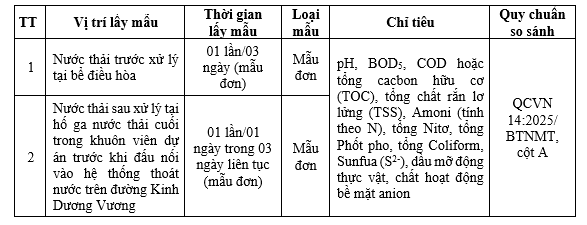
+ Waste monitoring program (automatic, continuous and periodic) according to the provisions of law
➢Periodic environmental monitoring program
Wastewater monitoring: The project is not subject to periodic wastewater monitoring (as prescribed in Article 97 of Decree No. 08/2022/ND-CP, amended and supplemented in Decree No. 05/2025/ND-CP of the Government)
Monitoring dust and industrial emissions: The project is not subject to periodic emissions monitoring (as prescribed in Article 98 of Decree No. 08/2022/ND-CP, amended and supplemented in Decree No. 05/2025/ND-CP of the Government)
➢Automatic and continuous waste monitoring program
Wastewater monitoring: The project is not subject to automatic, continuous wastewater monitoring (as prescribed in Article 97 of Decree No. 08/2022/ND-CP, amended and supplemented in Decree No. 05/2025/ND-CP of the Government)
Monitoring dust and industrial emissions: The project is not subject to automatic and continuous monitoring of emissions (as prescribed in Article 98 of Decree No. 08/2022/ND-CP, amended and supplemented in Decree No. 05/2025/ND-CP of the Government)
➢Other periodic environmental monitoring activities, automatic and continuous environmental monitoring activities according to relevant laws or as proposed by the project owner.
The project is not subject to periodic and continuous monitoring, so the content in this Section is not included.
V. COMMITMENT OF THE INVESTMENT PROJECT OWNER
Commitment during the construction phase
+ Ambient air quality meets QCVN 05:2023/BTNMT;
+ Noise meets QCVN 26:2025/BNNMT - National technical regulation on noise.
+ Construction wastewater, domestic wastewater, ensure treatment as mentioned in chapter 4. Ensure not to discharge untreated wastewater to receiving sources.
+ Solid waste is implemented in accordance with Decree 08/2022/ND-CP detailing a number of articles of the Law on Environmental Protection and Circular 02/2022/TT-BTNMT - Detailing a number of articles of the Law on Environmental Protection.
+ Commitment to transport and manage excavated soil according to regulations.
+ For hazardous waste: The investor will classify, collect, store and treat in accordance with Hazardous waste is collected, managed, etc. according to Circular 02/2022/TT-BTNMT - Detailing a number of articles of the Law on Environmental Protection and handled according to Decree 08/2022/ND-CP detailing a number of articles of the Law on Environmental Protection.
+ Commitment to compensation for damages and troubleshooting in case the project affects the surrounding environment and residential communities in the area
Commitment during the operation phase
+ Noise meets QCVN 26:2025/BNNMT - National technical regulation on noise.
+ Vibration: ensure that the vibration generated from the project's operation will meet the Standard Maximum allowable limit for vibration in public and residential areas according to QCVN 27:2025/BNNMT
+ Wastewater: collect all generated wastewater and lead it to the local wastewater treatment system at the treatment project and ensure it meets applicable standards: QCVN 14:2025/BTNMT (column A) before being put into the area's general drainage system
+ Domestic solid waste is carried out according to current regulations
+ For waste: The investor will classify, collect, store and treat waste according to current regulations.
Related Projects
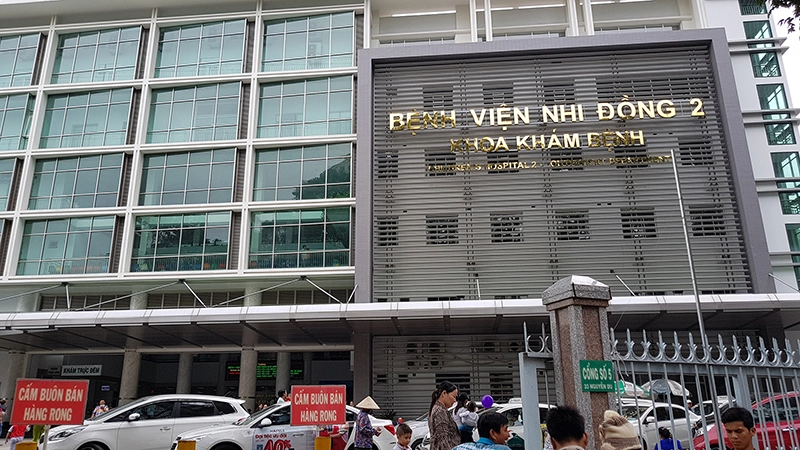
CHILDREN'S HOSPITAL 2 HIGH-TECH TREATMENT CENTER CONSTRUCTION PROJECT
CONTRACT FOR CONSTRUCTION PROJECT OF HIGH-TECH TREATMENT CENTER OF CHILDREN'S HOSPITAL 2

CAN THO CITY CANCER HOSPITAL CONSTRUCTION INVESTMENT PROJECT
CAN THO CITY CANCER HOSPITAL CONSTRUCTION INVESTMENT PROJECT CONTRACT

NEW CONSTRUCTION PROJECT OF BLOOD TRANSFUSION AND HEMATOLOGY HOSPITAL (FACILITY 2)
CONTRACT FOR NEW CONSTRUCTION PROJECT OF BLOOD TRANSFUSION AND HEMATOLOGY HOSPITAL (FACILITY 2)